
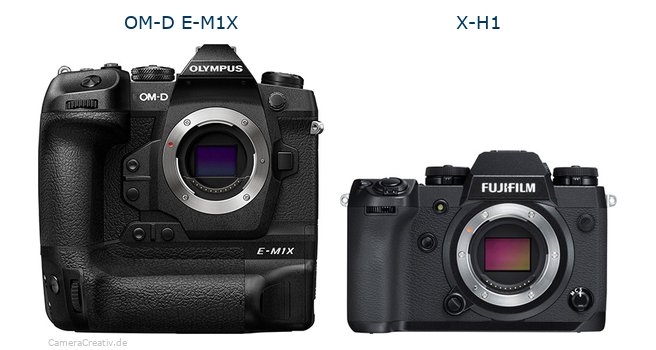
Here you can find digital cameras comparison. Pick up with the best rating.
Cameras which are being compared are Mirrorless cameras.

Learn more about compared cameras specifications below. |
|
|
Olympus OM-D E-M1X vs Fujifilm X-H1 Specs |
|
|
OM-D E-M1X
All specs: Main page for OM-D E-M1X |
X-H1
All specs: Main page for X-H1 |
|
OM-D E-M1X vs X-H1 Sensors |
|
|
On the pictures below the sensor areas of cameras are highlighted. This infographic highlights the sensor areas of both models compared to other common sensor formats: Advantage: Fujifilm X-H1 |
|
OM-D E-M1X vs X-H1: Viewfinder OM-D E-M1X has an electronic viewfinder and it’s resolution is 2.36 megapixel with magnification of 0.83x. X-H1 has an electronic viewfinder with resolution 3.69 megapixel, it’s magnification is 0.75x. Viewfinder magnifications of compared cameras. The black area shows a magnification of 1x, relative to native size; in red is a magnification of 0.85x. |
||
|
OM-D E-M1X (0.83x) |
X-H1 (0.75x) |
|
|
Note: Differences in the image area are the result of different image ratios, 3:2 or 4:3. That can make it difficult to compare the viewfinder magnification of both cameras. |
||
|
Olympus OM-D E-M1X VS Fujifilm X-H1 Other Specs Comparison |
|
Why is Olympus OM-D E-M1X a better choice |
||
|
OM-D E-M1X |
X-H1 |
|
| Higher speed (4, frames/second) | 18 | 14 |
| Better sensibility (4) | 64 – 25600 ISO | 200 – 12800 ISO |
| Larger lens selection (3) | 80 | 25 |
| Longer battery life (3, photos) | 870 | 310 |
| GPS (2) | ||
|
Conclusion: Advantages of the OM-D E-M1X are that the camera is faster, the larger sensitivity and the larger selection of lenses. We also like that the battery has more stamina and the built-in GPS. The OM-D E-M1X scores 16 points. |
||
|
Otherwise why to choose Fujifilm X-H1 |
||
|
OM-D E-M1X |
X-H1 |
|
| Larger sensor (5) | Four Thirds | APS-C |
| Wider resolution (5, megapixel) | 20.40 | 24.30 |
| Auto Focus points (4) | 121 | 325 |
| Better viewfinder (4, Megapixel) | 2.36 | 3.69 |
| Weighs less (2) | 997g (32.2 oz.) |
673g (21.7 oz.) |
| More portable (2) | 1707cm³ (108 cu.in.) |
1163cm³ (73 cu.in.) |
|
Conclusion: Advantages of the X-H1 are the larger sensor, the higher resolution and the faster and more accurate auto focus. Additional pros for the Fujifilm are the better viewfinder, the lower weight than the OM-D E-M1X and the more compact size. Yields 22 points for the X-H1. |
||
|
Common Specs for both cameras compared |
||
|
OM-D E-M1X |
X-H1 |
|
| Sensor cleaning | ||
| Image stabilizer | ||
| Sensor resolution (MP) | 1.04 | 1.04 |
| Articulated screen | ||
| Touch screen | ||
| Video resolution | 4096 x 2160 | 4096 x 2160 |
| External microphone | ||
| WiFi | ||
| Environmental sealing | ||
| Olympus OM-D E-M1X VS Fujifilm X-H1 Dimensions |
|
Look at front view of the OM-D E-M1X and X-H1 |
|
Top view of cameras |
|
|
Total scores Here’s the total score according to comparison above: |
|
|
Olympus OM-D E-M1X |
Fujifilm X-H1 |
|
16
|
22
|
|
We recommend Fujifilm X-H1 as better choice. |
|