
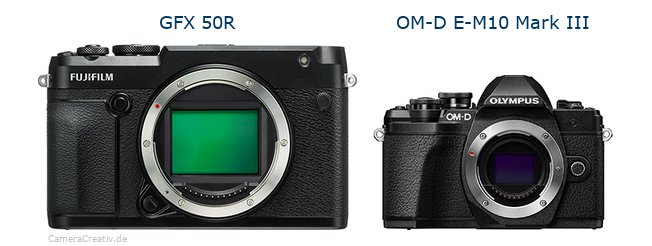
Here you can find digital cameras comparison. Pick up with the best rating.
Cameras which are being compared are Mirrorless cameras.

Learn more about compared cameras specifications below. |
|
|
Fujifilm GFX 50R vs Olympus OM-D E-M10 Mark III Specs |
|
|
GFX 50R
All specs: Main page for GFX 50R |
OM-D E-M10 Mark III
All specs: Main page for OM-D E-M10 Mark III |
|
GFX 50R vs OM-D E-M10 Mark III Sensors |
|
|
On the pictures below the sensor areas of cameras are highlighted. This infographic highlights the sensor areas of both models compared to other common sensor formats: Better choice: Fujifilm GFX 50R |
|
GFX 50R vs OM-D E-M10 Mark III: Viewfinder GFX 50R has an electronic viewfinder and it’s resolution is 3.69 megapixel with magnification of 0.77x. OM-D E-M10 Mark III has an electronic viewfinder with resolution 2.36 megapixel, it’s magnification is 0.61x. Viewfinder magnifications of compared cameras. The black area shows a magnification of 1x, relative to native size; in red is a magnification of 0.85x. |
||
|
GFX 50R (0.77x) |
OM-D E-M10 Mark III (0.61x) |
|
|
Advantage: Fujifilm GFX 50R |
||
|
Fujifilm GFX 50R VS Olympus OM-D E-M10 Mark III Other Specs Comparison |
|
Why is Fujifilm GFX 50R a better choice |
||
|
GFX 50R |
OM-D E-M10 Mark III |
|
| Larger sensor (5) | Medium format | Four Thirds |
| Wider resolution (5, megapixel) | 51.40 | 16.10 |
| Better viewfinder (4, Megapixel) | 3.69 | 2.36 |
| Better monitor (2, Megapixel) | 2.36 | 1.04 |
| External microphone (2) | ||
| Longer battery life (3, photos) | 400 | 330 |
| USB 3.0 (2) | ||
|
Conclusion: Advantages of the GFX 50R are the larger sensor, the higher resolution and the better viewfinder. We also like that the display has a higher resolution, the connector for an external microphone and that the battery has more stamina. Another advantage over the OM-D E-M10 Mark III: the support for USB 3.0. HArdly a luxury, given today’s image size and the requirements of 4K video. The GFX 50R scores 23 points. |
||
|
Otherwise why to choose Olympus OM-D E-M10 Mark III |
||
|
GFX 50R |
OM-D E-M10 Mark III |
|
| Higher speed (4, frames/second) | 3 | 8 |
| Auto Focus points (4) | 117 | 121 |
| Better sensibility (4) | 100 – 12800 ISO | 100 – 25600 ISO |
| Larger lens selection (3) | 5 | 80 |
| Built-in flash (2) | ||
| Image stabilizer (3) | ||
| Better Video (2) | 1920 x 1080 | 3840 x 2160 |
| Weighs less (2) | 775g (25.0 oz.) |
410g (13.2 oz.) |
| More portable (2) | 1030cm³ (65 cu.in.) |
503cm³ (32 cu.in.) |
|
Conclusion: Advantages of the OM-D E-M10 Mark III are that the camera is faster, the faster and more accurate auto focus and the larger sensitivity. We also like the larger selection of lenses, the built-in flash and the optical image stabilizer. A nice touch is the superior video recording, the lower weight than the GFX 50R and the more compact size. Yields 26 points for the OM-D E-M10 Mark III. |
||
|
Common Specs for both cameras compared |
||
|
GFX 50R |
OM-D E-M10 Mark III |
|
| Sensor cleaning | ||
| Articulated screen | ||
| Touch screen | ||
| WiFi | ||
| Fujifilm GFX 50R VS Olympus OM-D E-M10 Mark III Dimensions |
|
Look at front view of the GFX 50R and OM-D E-M10 Mark III |
|
Top view of cameras |
|
|
Total scores Here’s the total score according to comparison above: |
|
|
Fujifilm GFX 50R |
Olympus OM-D E-M10 Mark III |
|
23
|
26
|
|
We advise to choose the newest model: Fujifilm GFX 50R. |
|