
Here you can find digital cameras comparison. Pick up with the best rating.
Cameras which are being compared are Mirrorless cameras.

Learn more about compared cameras specifications below. |
|
|
Olympus OM-D E-M1X vs Fujifilm X-T2 Specs |
|
|
OM-D E-M1X
All specs: Main page for OM-D E-M1X |
X-T2
All specs: Main page for X-T2 |
|
OM-D E-M1X vs X-T2 Sensors |
|
|
On the pictures below the sensor areas of cameras are highlighted. This infographic highlights the sensor areas of both models compared to other common sensor formats: Advantage: Fujifilm X-T2 |
|
OM-D E-M1X vs X-T2: Viewfinder OM-D E-M1X has an electronic viewfinder and it’s resolution is 2.36 megapixel with magnification of 0.83x. X-T2 has an electronic viewfinder with resolution 2.36 megapixel, it’s magnification is 0.77x. Viewfinder magnifications of compared cameras. The black area shows a magnification of 1x, relative to native size; in red is a magnification of 0.85x. |
||
|
OM-D E-M1X (0.83x) |
X-T2 (0.77x) |
|
|
Note: Differences in the image area are the result of different image ratios, 3:2 or 4:3. That can make it difficult to compare the viewfinder magnification of both cameras. |
||
|
Olympus OM-D E-M1X VS Fujifilm X-T2 Other Specs Comparison |
|
Why is Olympus OM-D E-M1X a better choice |
||
|
OM-D E-M1X |
X-T2 |
|
| Higher speed (4, frames/second) | 18 | 8 |
| Better sensibility (4) | 64 – 25600 ISO | 200 – 12800 ISO |
| Larger lens selection (3) | 80 | 25 |
| Image stabilizer (3) | ||
| Touch screen (2) | ||
| Better Video (2) | 4096 x 2160 | 3840 x 2160 |
| Longer battery life (3, photos) | 870 | 340 |
| GPS (2) | ||
|
Conclusion: Advantages of the OM-D E-M1X are that the camera is faster, the larger sensitivity and the larger selection of lenses. We also like the optical image stabilizer, the rather comfortable touch screen and the superior video recording. A recommendation of the OM-D E-M1X is made easy by that the battery has more stamina and the built-in GPS. The OM-D E-M1X scores 23 points. |
||
|
Otherwise why to choose Fujifilm X-T2 |
||
|
OM-D E-M1X |
X-T2 |
|
| Larger sensor (5) | Four Thirds | APS-C |
| Wider resolution (5, megapixel) | 20.40 | 24.30 |
| Auto Focus points (4) | 121 | 325 |
| Weighs less (2) | 997g (32.2 oz.) |
507g (16.4 oz.) |
| More portable (2) | 1707cm³ (108 cu.in.) |
598cm³ (38 cu.in.) |
|
Conclusion: Advantages of the X-T2 are the larger sensor, the higher resolution and the faster and more accurate auto focus. Additional pros for the Fujifilm are the lower weight than the OM-D E-M1X and the more compact size. Yields 18 points for the X-T2. |
||
|
Common Specs for both cameras compared |
||
|
OM-D E-M1X |
X-T2 |
|
| Sensor cleaning | ||
| Sensor resolution (MP) | 1.04 | 1.04 |
| Articulated screen | ||
| External microphone | ||
| WiFi | ||
| Environmental sealing | ||
| Olympus OM-D E-M1X VS Fujifilm X-T2 Dimensions |
|
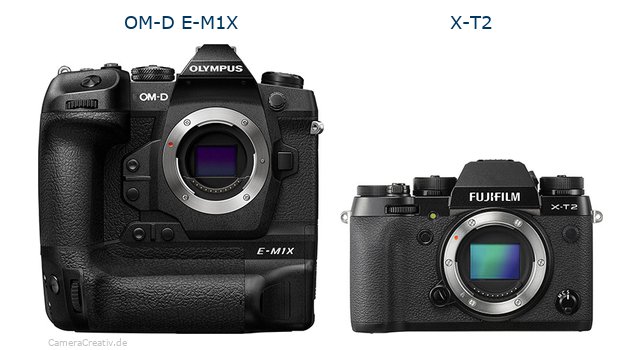
Look at front view of the OM-D E-M1X and X-T2 |
|
Top view of cameras |
|
|
Total scores Here’s the total score according to comparison above: |
|
|
Olympus OM-D E-M1X |
Fujifilm X-T2 |
|
23
|
18
|
|
We recommend Olympus OM-D E-M1X as better choice. |
|