
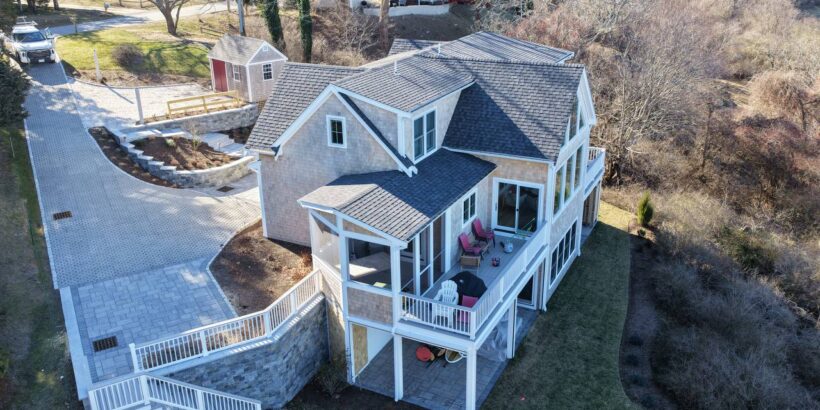
Coastal architecture on Cape Cod demands exterior systems engineered to withstand salt aerosols, high-velocity winds, rapid thermal cycling, and heavy seasonal precipitation. For a recent private residence in Orleans, Massachusetts, our team executed a comprehensive exterior transformation centered on a high-performance asphalt roofing system installed across a newly constructed addition, paired with a complete natural white cedar siding upgrade across the primary structure. Completed in a tightly coordinated 7-day window, this project demonstrates how modern roofing engineering, when integrated with precision cladding protocols and disciplined workflow management, creates a unified, weather-resistant envelope capable of outperforming traditional coastal builds. Below, we break down the technical specifications, installation methodologies, and material synergies that define a resilient asphalt roofing system and its complementary exterior components.
Architectural Asphalt Roofing: Material Science & Complex Geometry Execution
Modern architectural asphalt shingles have evolved far beyond basic weather barriers. Premium dimensional profiles utilize a fiberglass-reinforced core saturated with polymer-modified asphalt, topped with ceramic-coated mineral granules that deliver Class 4 impact resistance, 130+ mph wind uplift ratings, and enhanced UV reflectivity. For this Orleans project, we specified a deep charcoal gray dimensional shingle system, selected for its structural rigidity, thermal stability, and proven track record in marine climates where freeze-thaw cycles and salt-laden rain accelerate material degradation.
The roof’s complex geometry—multiple intersecting slopes, varying pitch transitions, dormer penetrations, and a red brick chimney—required custom flashing coordination and precise water-shedding calculations. Our installation protocol began with a continuous ice-and-water shield membrane across all eaves, valleys, and penetrations, extending 24 inches past interior wall lines to prevent wind-driven rain intrusion. Valleys were constructed using a woven shingle technique rather than exposed metal liners, creating a monolithic drainage surface that eliminates fastener exposure and reduces thermal bridging.
Critical detailing steps included:
- Step flashing integration at the chimney using 20-oz galvanized steel interlaced with each shingle course, sealed with polyurethane elastomeric compound to accommodate differential thermal movement between masonry and wood framing
- Ridge cap installation calibrated to maintain balanced attic ventilation, reducing moisture condensation during coastal temperature inversions
- Wind-uplift mitigation through consistent nail placement within the manufacturer’s specified nailing zone, ensuring full adhesive strip activation during thermal cycling
When homeowners evaluate asphalt roof replacement cost, they’re weighing upfront investment against lifecycle performance. A professionally executed architectural asphalt system delivers 40–50 years of reliable service with minimal maintenance, outperforming many premium alternatives in cost-to-durability ratio while maintaining architectural harmony. The dark charcoal profile creates deliberate visual contrast with warm cedar tones and crisp white trim, reinforcing the home’s classic coastal character without sacrificing engineered performance.
Complementary Cladding: Natural Cedar Siding Integration
While the asphalt roofing system forms the primary weather barrier, the facade cladding requires equal engineering precision to prevent moisture entrapment and structural degradation. The residence’s exterior was upgraded with natural white cedar shingles, a material traditionally specified for New England coastal architecture due to its high extractive content, low shrinkage coefficient, and natural resistance to fungal colonization and insect activity.
Cedar shingle siding installation on this project followed strict ventilation and fastening protocols. Each shingle was spaced with a consistent 1/8” back-ventilation gap to establish a continuous drainage plane, allowing capillary moisture to escape rather than accumulate against the sheathing. Fasteners were 316-grade stainless steel ring-shank nails, driven to controlled depths that prevent fiber crushing while maintaining 1.25” penetration into structural framing. Expansion gaps were maintained at all perimeter transitions to accommodate seasonal dimensional changes without buckling.
Complex architectural elements—including bay windows, intersecting corners, and multi-plane trim assemblies—required custom templating and precision cutting. Rather than relying on traditional corner boards, which create vulnerable vertical seams, our team implemented a staggered interlocking sequence that maintains continuous weather protection while delivering the seamless, architecturally refined finish characteristic of high-end Cape Cod design. Over 12–24 months, UV exposure and natural oxidation will transition the surface to a uniform silver-gray patina—a self-maintaining protective layer that enhances moisture resistance while preserving structural integrity.
The 1-Week Execution Protocol: Parallel Workflows & Quality Control
Completing a full asphalt roofing installation on a new addition alongside a complete cedar siding replacement in seven days requires synchronized workflow management and real-time environmental adaptation. Coastal weather windows are narrow; sustained winds over 20 mph or relative humidity above 75% halt critical shingle sealing, flashing integration, and fastener verification steps.
We structured the project into overlapping phases:
- Days 1–2: Substrate preparation, moisture verification, ice-and-water shield application, and architectural asphalt shingle installation progressing from eaves to ridge. Simultaneous cedar siding staging and complex corner templating.
- Days 3–5: Cedar siding installation in rolling zones, beginning with bay window integration and corner detailing, followed by field shingle application. Roofing crews simultaneously completed valley weaving, chimney flashing, and ridge cap placement.
- Days 6–7: Final detailing, fastener depth verification, ventilation gap inspection, drainage path clearance, and comprehensive QA audit.
Pre-fabricated trim components, off-site shingle cutting, and cross-trained crews minimized site downtime. Daily quality control checklists enforced zero tolerance for misaligned courses, inconsistent nail placement, or compromised flashing seals. The synchronized workflow succeeded because structural integrity was prioritized over speed, material compatibility was verified before installation, and every transition detail was inspected before concealment.
Final Synergy & Long-Term Performance Expectations
The completed exterior demonstrates how complementary materials function as a unified coastal defense system. The architectural asphalt roofing dynamically sheds water, manages thermal stress, and resists wind uplift, while the ventilated cedar cladding, precision flashing, and sealed expansion joints create secondary defense layers that protect the structural envelope long-term.
Maintenance expectations are straightforward but critical:
- Asphalt roofing: Bi-annual debris clearance in valleys and around penetrations; post-storm inspection for displaced shingles or compromised sealant
- Cedar siding: Gentle low-pressure rinsing twice annually to remove salt crystallization; verification of fastener heads and trim sealant flexibility
- Ventilation & drainage: Annual inspection of ridge caps, soffit vents, and ground-level runoff paths to prevent moisture accumulation
With proper stewardship, this integrated exterior system will reliably exceed 40 years of service in Orleans’ marine climate, aging gracefully while maintaining engineered performance.
Final Notes for Coastal Renovation Professionals
Successful coastal upgrades require more than premium materials—they demand an understanding of material behavior, environmental stressors, and precision installation protocols. This Orleans project demonstrates how modern asphalt roofing engineering, when integrated with disciplined cladding workflows and weather-aware project management, creates exteriors that perform as reliably as they endure. For builders, architects, and homeowners navigating similar coastal renovations, the difference between premature failure and generational performance lies in the details: underlayment continuity, fastener compatibility, and uncompromising transition detailing.